sections get ref markers if and when they need them
How to build and view docs locally
*<word>*- italics
**<word>**- bold
:edb-alt-title: Databases
What does this do?
:eql-statement:
What does this do?
Emojis- Do we use and when?
One example of current usage at ddl/access_policies
:eql-haswith:
What does this do?
:index: poly polymorphism nested shapes
Add search terms that don’t appear (in the text? title?)
Locations of other documentations that are pulled into the build
When does a page get a right-side on-page menu?
Guidelines
When something you want to do in docs is not specifically mentioned here, try to mirror something similar that already exists in our documentation
Be careful about where you put your changes, whether that’s where a new page goes in the document tree or where a new paragraph goes on an existing page.
Ask, “When a person has the problem I anticipate that the documentation solves, where would they look?”
If your documentation change doesn’t solve a problem, it may not be necessary.
This isn’t intended to trivialize things like typos, incorrect punctuation, and poor word choice. Those issues can make our docs harder to read, which is a problem that needs solving.
Questions
----------
What should this be? I thought it would be a horizontal rule, but it doesn’t render.
Currently unused. No need to document this.
versionchanged appears to be a block, but versionadded is not. How does versionadded work? What does it apply to? How does it know what to hide?
until next heading of the same level or higher?
versionchanged and versionadded are both builtin sphinx directives, except we have custom overrides for them that makes them behave slightly differently to how they’re documented in sphinx. They both have to have a version argument, and can both be used similar to a note block if they have content. versionadded currently also has different behaviour if it doesn’t have content, and is used either as the first directive of a page (has to be before any refs at the top to make sure they get properly attached to the page title), immediately after a section header, or inside a desc block. In these cases it won’t get rendered, but instead marks the page, section or desc block with the version, which then means it will be affected by the version switcher.
Can -diff be added to any language designator in the code block directive?
As far as I remember: yes. The -diff suffix is handled by the code block rendering code, and if it’s present each line of the code is expected to start with + , - , or which will get stripped away, and the line will be rendered green or red (or normal).
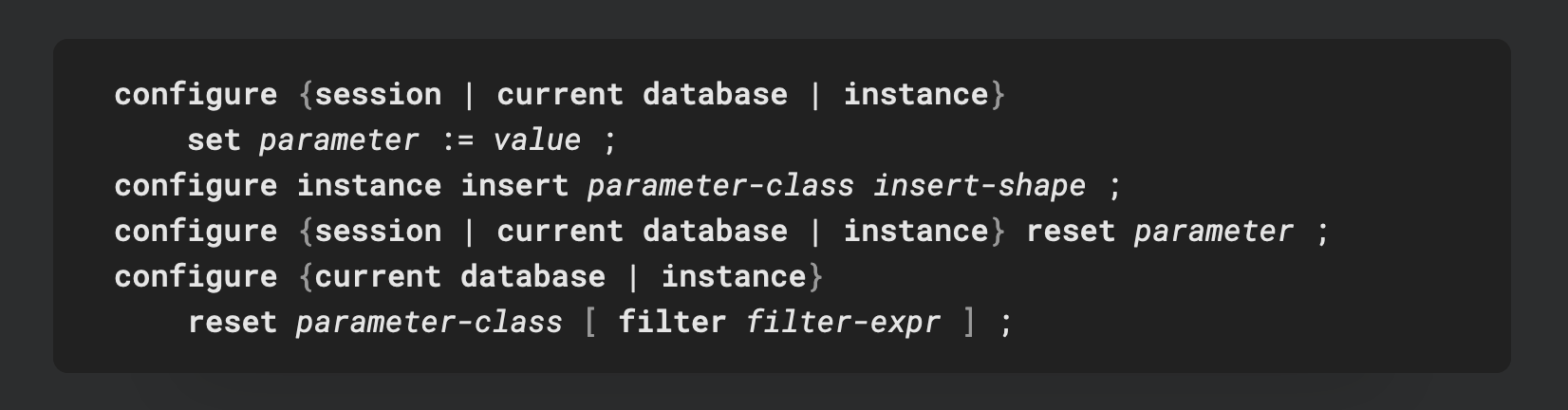
Can also look like this: :eql:synopsis:`configure session`
What does the backtick portion do?
Sometimes doesn’t have the name or backticks. Why?
:eql:synopsis:configure session is broken into three parts - :eql: which is part of the EdgeQL Sphinx domain, synopsis which is the directive, and then configure session is the reference, correct.
first three letters represent the section of the docs
What are all the values?
Makes a link to GitHub commit or issue
on the edgedb/edgedb repo?
I believe it works for any repo, edgedb/edgedb is just the default if not specified, which I think you can do like this: :eql:gh:edgedb/edgedb-js/#123
:edb-alt-title: Databases
What does this do?
The alt title is used in place of the page title when rendered. The url and nav still use the real title, so it can be used if you want a longer title on the page that doesn’t fit in the nav, like this page for example: https://www.edgedb.com/docs/datamodel/computeds
When does a page get a right-side on-page menu?
**When there’s space 😄. So when the window is both wide enough and the list of subheadings is short enough that it will fit without scrolling.